
Peak-hour shortage
Drinks slow down when the ice bin runs low.
Commercial Nugget Ice Maker
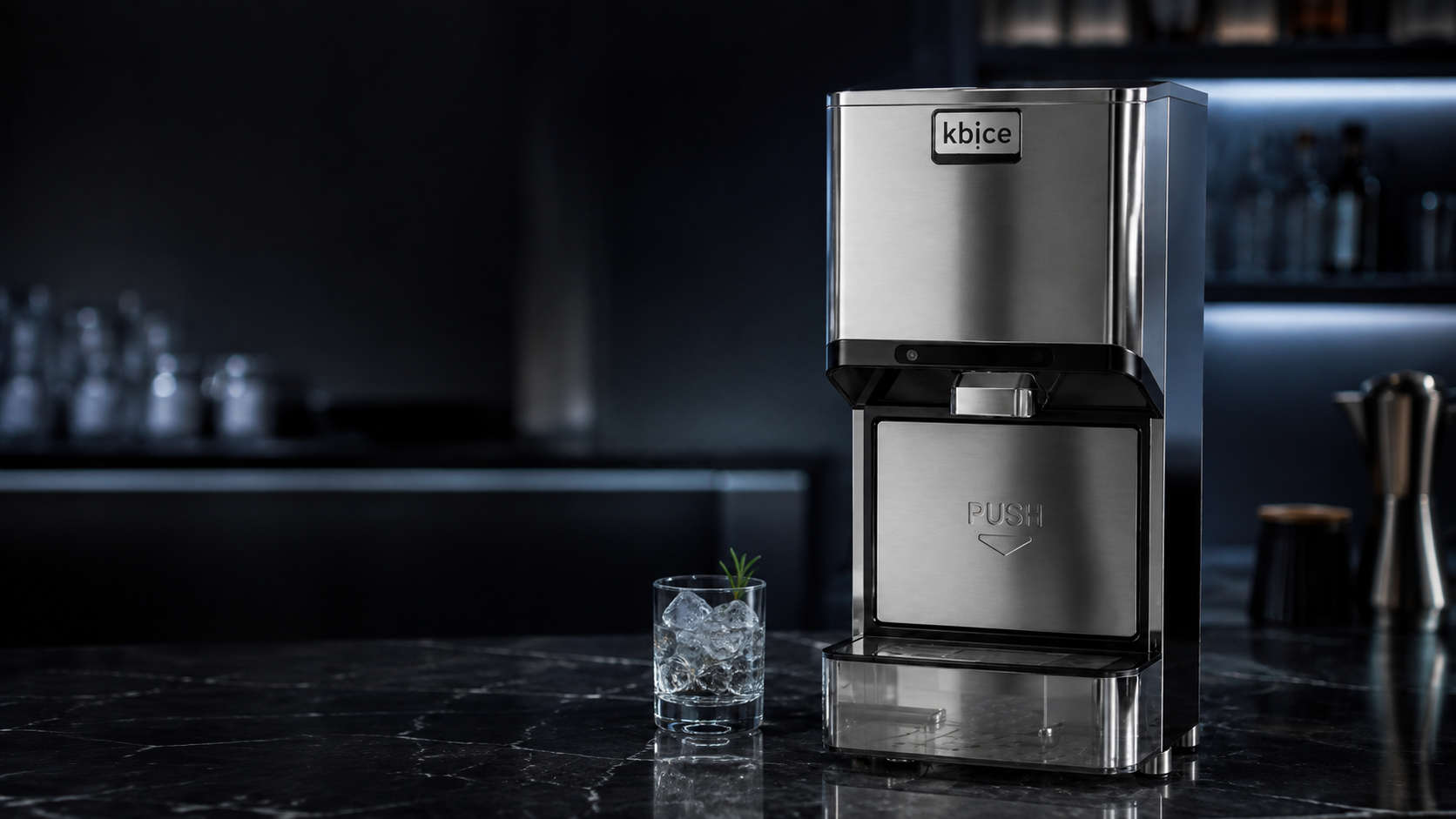
KB5 is a compact commercial nugget ice platform for cafés, restaurants, bubble tea shops and beverage counters that need reliable everyday ice production without oversizing the machine.
Try the rush-hour sizing calculator ↓
Singapore testing indicates approximately 27 kg/day under local conditions. Actual production depends on ambient temperature, humidity and usage. Final configuration is confirmed at quotation stage.
The operations problem
For F&B operators, ice affects service speed, consistency, beverage quality and the customer experience.
Drinks slow down when the ice bin runs low.
Storage, handling, delivery timing and hygiene become recurring operational work.
Different ice size and melt behaviour can change taste, dilution and presentation.
Separate water, ice and hot-water equipment compete for valuable counter space.
Why nugget ice
Nugget ice is not just cold — it becomes part of the drink experience.
Soft, satisfying mouthfeel for iced coffee, fruit tea, bubble tea and mocktails.
More surface area helps beverages cool quickly during service.
A distinctive ice format that makes drinks feel more crafted and memorable.
Commercial performance
KB5 is built for regular commercial cold-drink demand and positioned as a compact, right-sized machine for everyday F&B beverage counters.
Rated production capacity; actual daily output varies by conditions.
Use this Singapore-tested planning reference for Singapore sizing.
A ready-ice buffer for busy periods, supported by ongoing production as ice is used.
Capacity sizing
A 5 kg storage bin is a ready-ice reserve, not a 5 kg limit on service. As ice is used, KB5 continues producing to replenish the supply. Size your setup around the ice already stored, ongoing production and the timing of your busiest periods.
Available at the start of a rush when the bin is full.
Calculated from the 30 kg per 24-hour rating.
Calculated from approximately 27 kg per 24 hours in Singapore testing.
Interactive capacity planner
Tell us how many cups you serve and how much ice goes into each one. See how a ready reserve and ongoing production work together.
Starting with 5 kg of ice, using the Singapore-test average and a 20% planning allowance.
Loading your estimate…
Opens a WhatsApp draft with these figures. You choose whether to send it.
The model assumes an already-running machine and evenly spread demand at the selected average output. Ice arrives gradually; a sudden burst can empty the bin sooner. Production pauses when storage is full. Actual results depend on operating conditions, including temperature and humidity.
Check the whole day separately: the initial reserve is ice made earlier, not extra daily production. Repeated rushes need recovery time. Do not assume the full 24-hour output is available during a shorter operating day.
Drink demand per hour = cups per hour × ice per cup in grams ÷ 1,000.
Planned demand per hour = (drink demand + other ice use per hour) × (1 + allowance ÷ 100).
Average production = selected daily output ÷ 24. The model uses 1.125 kg/h for the Singapore result or 1.25 kg/h for the rating.
Reserve change per hour = production − planned demand. The projected reserve is limited to 0–5 kg; unmet demand is shown as a shortfall. Production that cannot fit in a full bin is not counted as stored ice.
Cup capacity over the rush is a mathematical upper estimate: ((starting reserve + potential production during the rush) ÷ allowance multiplier − other ice use during the rush) ÷ kg per cup, rounded down. It assumes demand is spread out, not all cups served at once.
Time to refill = (5 kg − projected end reserve) ÷ average production, with no further ice use. Time-to-empty uses planned demand including the allowance. All outputs are calculated estimates, not measured test results.
For a defined service period, consider the starting reserve together with the ice produced while drinks are being served.
| Service period | At rated average 1.25 kg/h |
At Singapore-test average 1.125 kg/h |
|---|---|---|
| 1-hour service period | 6.25 kg | 6.13 kg |
| 2-hour service period | 7.50 kg | 7.25 kg |
| 4-hour service period | 10.00 kg | 9.50 kg |
Calculated illustrations, not guaranteed peak-throughput or hourly test results. Hourly averages are derived from the 24-hour figures. They assume a full bin, an already-running machine, uninterrupted production, and enough ice being used to make room for replenishment. New ice becomes available gradually, not all at the start. Allow for losses, downtime and a service buffer; actual output varies with operating conditions. Demand can still empty the bin early if concentrated into a short burst.
At the Singapore-test average, 5 kg already stored + 2.25 kg produced during service gives approximately 7.25 kg across two hours. At an assumed 150 g of ice per drink, that is about 48 drinks before allowing for losses, preparation ice and a safety buffer. This is a planning example, not a guaranteed drinks-per-hour claim.
Quieter periods can allow the reserve to rebuild before the next rush. From empty, refilling 5 kg would take approximately 4 hours at the rated average, or about 4 hours 27 minutes at the Singapore-test average, assuming steady production and no further ice use.
The 5 kg reserve is ice made earlier, not an extra 5 kg of new production every day. Daily demand must still fit actual output, operating hours and recovery between peaks. A full bin cannot accumulate an unlimited overnight reserve.
KB5 may suit a busier service period than its 5 kg storage figure alone suggests. The examples below provide a separate whole-day demand check; the final fit also depends on peak timing, ice per drink and how much production can occur between rushes.
| Outlet type | Example volume | Assumed ice use | Estimated daily demand | What to assess |
|---|---|---|---|---|
| Café | 80–200 iced drinks/day | 180 g / drink | 17–43 kg/day | Match the actual menu and peaks. A full reserve supports a short rush; the upper end exceeds single-unit daily production. |
| Bubble tea / fruit tea | 120–230 drinks/day | 200 g / drink | 29–55 kg/day | At this assumed ice dose and buffer, the range exceeds the approximately 27 kg/day local-test reference. Verify recipe demand or plan supplemental ice capacity. |
| Restaurant | 80–180 iced covers/day | 120 g / guest | 12–26 kg/day | Potential fit when production hours and recovery support the full day. Check the reserve needed for each lunch or dinner peak. |
| Dessert / mocktail shop | 80–160 items/day | 200 g / item | 19–38 kg/day | Assess recipe portions and rush duration. The reserve helps with bursts; sustained demand above local output requires additional capacity. |
Illustrative daily estimates include a 20% buffer on the stated drink ice only, rounded to whole kilograms. Add preparation and cooling demand separately, including its buffer. The 30 kg rating and approximately 27 kg Singapore test result are both per 24 hours; do not assume this entire output is produced during a shorter service day. Verify site performance and retain headroom before final selection. Share your menu, ice portions, operating hours and peak-hour pattern for a setup recommendation.
Technical specifications
The details your operations, facilities and purchasing teams need when assessing capacity, placement and power requirements.
Who is KB5 for?
Best for businesses and facilities with regular or higher-volume cold-drink demand.
Iced coffee, tea, matcha and refreshers. Best when drink volume is steady throughout the day.
Cup ice, tea cooling and batching. Check daily and peak-hour ice demand; higher-volume outlets may require more than one unit.
Soft drinks, water service and mocktails. A practical support machine for daily service ice.
Fruit tea, toppings and cold dessert drinks where the ice becomes part of the customer experience.
Staff refreshment, meetings and visitors with heavier shared use.
Lounges, service points and refreshment zones that benefit from distributed small service points.
Configured for your outlet
KB5 can be configured around your menu, service workflow and outlet requirements rather than forced into a one-size-fits-all appliance.
Dedicated commercial nugget ice for outlets that already have their water systems in place.
Cold-drink support plus preparation or drinking water from one service point.
Project configuration for tea preparation or batching before drinks are served cold.
Custom configurations are subject to engineering confirmation, site requirements and quotation.
Commercial economics
On-site nugget ice can reduce dependency on deliveries, freezer space and emergency ice runs while giving the outlet a more consistent service workflow.
Frequently asked questions
KB5 is rated at 30 kg / 24h. Singapore testing has shown approximately 27 kg / 24h under local conditions. Actual output varies with temperature, humidity and usage. Ready ice storage is 5 kg.
No. The 5 kg figure is storage capacity. As ice is used, ongoing production replenishes the reserve, so more than 5 kg can be served across a sufficiently long period. The 30 kg/24-hour rating equates to a calculated average of 1.25 kg/hour; the approximately 27 kg/24-hour Singapore result equates to 1.125 kg/hour. These are averages derived from daily figures, not guaranteed hourly output. Actual rush-hour suitability depends on starting stock, consumption timing, production conditions and recovery before the next peak.
KB5 is designed for cafés, bubble tea and fruit tea outlets, restaurants, bars, dessert shops, offices, hotels and facilities with regular commercial cold-drink demand.
Yes. Depending on the project, KB5 can be configured as nugget ice only, ice + ambient water, or a project hot-water + nugget ice setup. Final configuration is subject to engineering confirmation, site requirements and quotation.
Assess peak service and whole-day demand separately. For a rush, start with the ice already in the bin and add the ice produced as you serve. A full 5 kg bin plus two hours at the calculated Singapore-test average of 1.125 kg/hour gives approximately 7.25 kg across the period, before losses and a safety buffer. The new ice arrives gradually, so a concentrated burst can still empty the bin. Check recovery time, actual operating hours and daily ice needs as well; the 5 kg reserve is not additional daily production. Share your menu, portions and service pattern with our team for final sizing.
KB5 measures 370 × 546 × 750 mm and is AC-powered.
Net weight is 40 kg and gross weight is 45 kg.
The current product specification lists an 8-week lead time. Confirm timing with our team when requesting your quotation.
KB5 is quoted based on the commercial requirement. Use the Request a Quote button or WhatsApp our team to discuss your setup.
Commercial consultation
Send us your menu, drink volume, peak-hour pattern and available counter space. We’ll assess daily ice demand, confirm site fit and recommend the right configuration and quotation.